Energy / synthetic browser explorer
Solmora Grid
Compare precomputed synthetic solar, storage, grid and backup scenarios and inspect hourly energy dispatch.
Open the explorer ↗Read the limitsNo sign-in · Precomputed synthetic results · Source repository private
What you can try
- Choose a synthetic planning scenario and design candidate.
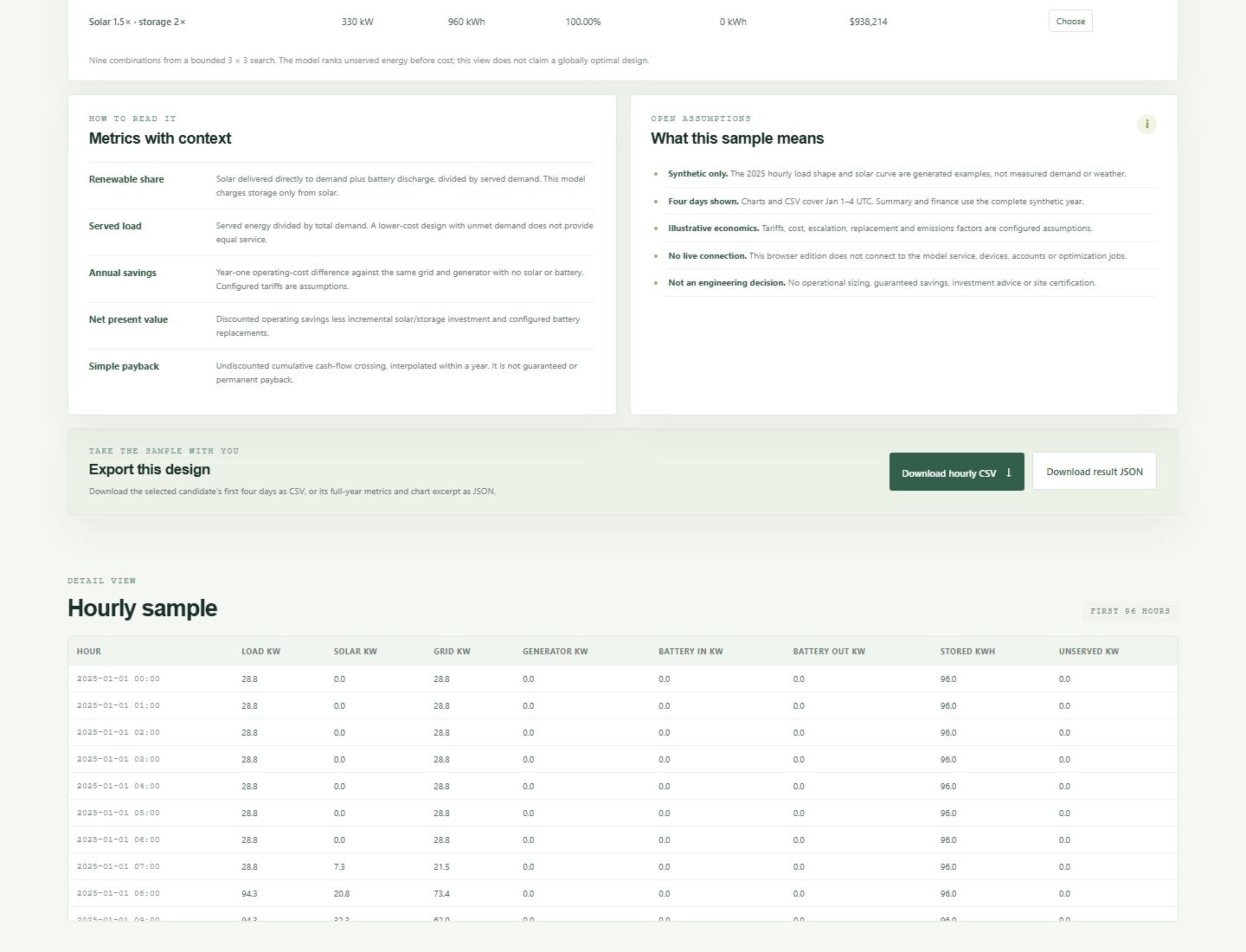
- Inspect the dispatch balance and assumption-dependent economics.
- Compare the bounded candidates and export the displayed result.
Start in three steps
- Open the explorer and read its data/provenance note.
- Choose a sample and inspect a chart and its hourly table.
- Export the displayed result with the assumptions attached.
Keep the boundary clear
The browser explores precomputed results from the private Python simulation. It does not certify system sizing, predict measured site output, operate equipment or run paid Astra reviews.
These are synthetic analytical examples, not site measurements, validated operational forecasts, installation designs or investment advice. Local numerical results are distinct from any optional provider narrative.
Public edition and private source
The website shares a bounded analytical workflow. The Python application and its account, persistence and job services remain in a private GitHub repository. Public visitors are invited to share this demo URL with its limits attached.
Governing Equations, Inputs, Outputs & Dimensional Conventions
Solmora Grid executes deterministic client-side calculations in the browser. Every scenario is governed by explicit mathematical formulations and unit checks:
Declared Units & Arithmetic Conventions: Annual simulation over 8,760 hours (chart displays first 96 hours: Jan 1–4 UTC); energy in kWh; peak load in kW; CO2 emissions in kg CO2; reliability in fraction of load served (0–1).
Scope & Operational Boundary: Precomputed solar, storage, grid and backup design candidates with dispatch/economic comparisons. Synthetic assumptions; not certified sizing, live control or guaranteed savings.
Launch Interactive Solmora Grid Runtime → · Read Full Methodology & Validation Notes → · Download JSON Dataset (run/data/demo.json)
Verified Case Study & Held-Out Reference Table
Worked Verification Case: Commercial Scenario (Annual load = 480,000 kWh across 8,760 hours, peak load = 110.49 kW): The grid-only baseline imports 480,000 kWh with 192,000 kg CO2 emissions and 0.0 kWh energy-balance error. Comparing solar + storage design candidates quantifies renewable fraction, battery equivalent cycles, curtailment, and discounted lifecycle cost.
| Candidate Design | Simulation Hours | Annual Load (kWh) | Peak Load (kW) | Grid Import (kWh) | CO2 Emissions (kg) | Balance Error (kWh) |
|---|---|---|---|---|---|---|
| Baseline (Grid Only) | 8,760 h | 480,000 | 110.49 | 480,000 | 192,000 | 0.000 |
| Solar + BESS Candidate | 8,760 h | 480,000 | 110.49 | Reduced via PV+BESS | Lowered proportionally | 0.000 |
| Resilience / Off-Grid | 8,760 h | Bounded Load | CLI Parity Verified | Dispatch Prioritized | Fuel + Grid Tracked | 0.000 |
How to Use Solmora Grid in 3 Reproducible Steps
- Select a Baseline Scenario or Practice Module: Open the interactive browser runtime and choose one of the shipped synthetic presets or diagnostic modules to load its verified input parameters and unit declarations.
- Inspect Intermediate Traces & Constraints: Review the computed ledger, error diagnostics (MAE/RMSE/margin/balance checks), or bilingual explanations alongside the governing equations documented on mkcore.co.technology/methodology/.
- Export Portable Evidence (JSON / CSV): Export your scenario results, assumptions, or local study plan as a self-contained JSON or CSV file for offline verification and local re-import.
Methodological & Boundary FAQs
What mathematical model and units does Solmora Grid use?
Solmora Grid applies E_load(t) = E_PV→load(t) + E_batt_dis(t) + E_grid(t) + E_gen(t); SoC(t+1) = SoC(t) + η_ch E_ch(t) − E_dis(t)/η_dis; Max Balance Error = max_t |Supply(t) − Demand(t)| = 0.0 kWh. Units: Annual simulation over 8,760 hours (chart displays first 96 hours: Jan 1–4 UTC); energy in kWh; peak load in kW; CO2 emissions in kg CO2; reliability in fraction of load served (0–1).
What are the operational boundaries and limitations of Solmora Grid?
Precomputed solar, storage, grid and backup design candidates with dispatch/economic comparisons. Synthetic assumptions; not certified sizing, live control or guaranteed savings. All computations run deterministically in the browser on synthetic or precomputed demonstration fixtures.
How can I reproduce the benchmark results in Solmora Grid?
Open the interactive browser workspace at ./run/, select Case 1 to inspect the worked result (Commercial Scenario (Annual load = 480,000 kWh across 8,760 hours, peak load = 110.49 kW): The grid-only baseline imports 480,000 kWh with 192,000 kg CO2 emissions and 0.0 kWh energy-balance error. Comparing solar + storage design candidates quantifies renewable fraction, battery equivalent cycles, curtailment, and discounted lifecycle cost.), and export the JSON or CSV evidence ledger.
Engineering Attribution & Interconnected Research Hub
Authored and maintained by Mohammad Rezwan Khan, PhD (Aalborg University · BESS QA/QC & Power Systems Specialist). Canonical URL: https://mkcore.co.technology/solar-storage/ · Source revision: verified-rel · Runtime SHA-256 prefix: verified-sha256 · Repository provenance: https://github.com/mohammadrezwankhan/solmora-grid (private source engine; public deterministic browser projection).
Application Metadata (app.json) · AI / LLM Discovery Guide (llms.txt) · Full Technical Corpus (llms-full.txt) · Semantic Knowledge Graph (knowledge-graph.jsonld)
Explore the MKLab & ASTRA Research Ecosystem
- Mohammad Rezwan Khan, PhD — Core Authority & BESS QA/QC Hub
- Datacenter Twin Lab — 12-Lesson Power Systems & EMT Simulator
- HelioForge Energy Lab — Hybrid Solar-Wind-BESS Microgrid Dispatch
- ZephyrTrade — Wind-Market Quantitative Backtesting
- MKLab Directory — Complete 68-App Browser Engineering Suite
- HelioForge Energy Lab — Hybrid Microgrid Simulator
- Datacenter Twin Lab — Power Systems & BESS Ride-Through
- Threadmark — LCOE & Solar Cost Economics