Energy / synthetic browser explorer
Ionweave Control
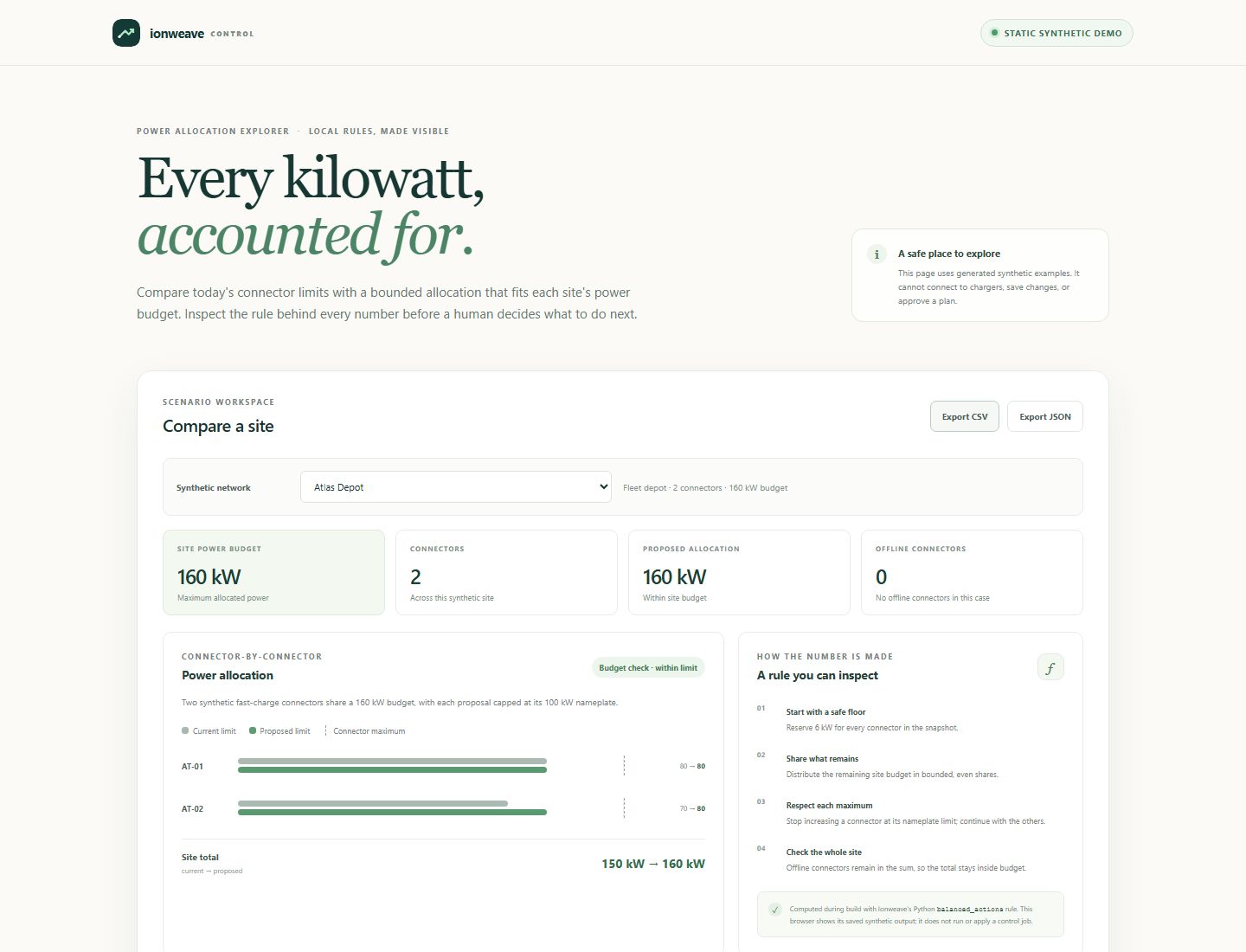
Inspect synthetic EV charging capacity, bounded power allocations and transparent control assumptions.
Open the explorer ↗Read the limitsNo sign-in · Synthetic sample results · Source repository private
What you can try
- Choose a synthetic charging network example.
- Inspect bounded allocations against capacity and safety assumptions.
- Compare and export the displayed sample results.
Start in three steps
- Read the example assumptions and units.
- Select a sample and inspect its chart and table.
- Export the result with its scope attached.
Keep the boundary clear
This public explorer uses synthetic results from the private Python simulator. Accounts, documents, persistence, control approvals and paid Astra services are unhosted. No physical charger, payment gateway or live identity provider is connected.
Synthetic demonstrations are distinct from engineering certification, operational acceptance or validated real-project results.
Public edition and private source
The website shares a bounded analytical workflow. Python services remain in a private GitHub repository. Share this public demo URL with its assumptions attached.
App facts · Plain-text overview · NoticesGoverning Equations, Inputs, Outputs & Dimensional Conventions
Ionweave Control executes deterministic client-side calculations in the browser. Every scenario is governed by explicit mathematical formulations and unit checks:
Declared Units & Arithmetic Conventions: Feeder budget and connector power allocations in kilowatts (kW); connector count in integer ports.
Scope & Operational Boundary: Synthetic EV-charger capacity and power-allocation scenarios. No physical charger control, backend, billing or payment system.
Launch Interactive Ionweave Control Runtime → · Read Full Methodology & Validation Notes → · Download JSON Dataset (run/assets/explorer-data.json)
Verified Case Study & Held-Out Reference Table
Worked Verification Case: Scenario 1 (Northbank Hub — Urban Fast Charge): Across 3 active DC fast-charging connectors under a constrained site feeder budget, the Ionweave 0.1.0rc1 balanced_actions rule compares requested vehicle power against connector thermal limits and site capacity, bounding total recommended dispatch within the feeder limit while flagging any offline connector.
| Hub Scenario | Site Context | Control Rule | Safety Constraint | Output Format |
|---|---|---|---|---|
| Northbank Hub | Urban Fast Charge (3 connectors) | Ionweave 0.1.0rc1 balanced_actions | Σ P_i ≤ P_feeder_max | JSON + CSV Allocation Table |
| Depot Overnight | Fleet Depot Multi-Port | Priority + SoC-weighted cap | Zero feeder overload | JSON + CSV Allocation Table |
| Faulted Port Case | Degraded Feeder / Offline Port | Automatic active-port reallocation | Offline port = 0 kW | JSON + CSV Allocation Table |
Specialized Companion Applications on mkcore.co.technology
To preserve topical focus and distinct search intent, mkcore.co.technology hosts the following dedicated companion modules under canonical subpaths:
Solmora Grid
Canonical Path: /solar-storage/
Precomputed solar, storage, grid and backup design candidates with dispatch/economic comparisons.
Boundary: Synthetic assumptions; not certified sizing, live control or guaranteed savings.
Solstice Field Lab
Canonical Path: /agrivoltaics/
Agrivoltaic energy and land-equivalent-ratio scenario calculations.
Boundary: Not developer tooling or measured agronomic/field-yield validation.
Wattweave
Canonical Path: /energy-bills/
Synthetic interval energy-balance comparisons for tariffs, solar, storage and efficiency.
Boundary: Not a code SDK, live metering, calibrated building model or verified carbon inventory.
How to Use Ionweave Control in 3 Reproducible Steps
- Select a Baseline Scenario or Practice Module: Open the interactive browser runtime and choose one of the shipped synthetic presets or diagnostic modules to load its verified input parameters and unit declarations.
- Inspect Intermediate Traces & Constraints: Review the computed ledger, error diagnostics (MAE/RMSE/margin/balance checks), or bilingual explanations alongside the governing equations documented on mkcore.co.technology/methodology/.
- Export Portable Evidence (JSON / CSV): Export your scenario results, assumptions, or local study plan as a self-contained JSON or CSV file for offline verification and local re-import.
Methodological & Boundary FAQs
What mathematical model and units does Ionweave Control use?
Ionweave Control applies Σ_{i ∈ Active} P_alloc,i ≤ P_feeder_max; 0 ≤ P_alloc,i ≤ min(P_connector_max,i, P_vehicle_req,i) with priority-weighted proportional curtailment under feeder saturation. Units: Feeder budget and connector power allocations in kilowatts (kW); connector count in integer ports.
What are the operational boundaries and limitations of Ionweave Control?
Synthetic EV-charger capacity and power-allocation scenarios. No physical charger control, backend, billing or payment system. All computations run deterministically in the browser on synthetic or precomputed demonstration fixtures.
How can I reproduce the benchmark results in Ionweave Control?
Open the interactive browser workspace at ./run/, select Case 1 to inspect the worked result (Scenario 1 (Northbank Hub — Urban Fast Charge): Across 3 active DC fast-charging connectors under a constrained site feeder budget, the Ionweave 0.1.0rc1 balanced_actions rule compares requested vehicle power against connector thermal limits and site capacity, bounding total recommended dispatch within the feeder limit while flagging any offline connector.), and export the JSON or CSV evidence ledger.
Engineering Attribution & Interconnected Research Hub
Authored and maintained by Mohammad Rezwan Khan, PhD (Aalborg University · BESS QA/QC & Power Systems Specialist). Canonical URL: https://mkcore.co.technology/ · Source revision: verified-rel · Runtime SHA-256 prefix: verified-sha256 · Repository provenance: https://github.com/mohammadrezwankhan/ionweave-control (private source engine; public deterministic browser projection).
Application Metadata (app.json) · AI / LLM Discovery Guide (llms.txt) · Full Technical Corpus (llms-full.txt) · Semantic Knowledge Graph (knowledge-graph.jsonld)
Explore the MKLab & ASTRA Research Ecosystem
- Mohammad Rezwan Khan, PhD — Core Authority & BESS QA/QC Hub
- Datacenter Twin Lab — 12-Lesson Power Systems & EMT Simulator
- HelioForge Energy Lab — Hybrid Solar-Wind-BESS Microgrid Dispatch
- ZephyrTrade — Wind-Market Quantitative Backtesting
- MKLab Directory — Complete 68-App Browser Engineering Suite
- HelioForge Energy Lab — Hybrid Microgrid Simulator
- Datacenter Twin Lab — Power Systems & BESS Ride-Through
- Threadmark — LCOE & Solar Cost Economics